
There is a moment, somewhere between the first and second day aboard an Australis cruise, when you realize that the food is part of the journey. Not a side note. Not a pleasant extra. The actual journey. You are navigating one of the most remote and protected waterways on the planet: the Strait of Magellan, the Beagle Channel, Cape Horn. As we navigate these remote waters, the cuisine on board highlights locally sourced ingredients, carefully selected from regional producers who sustainably support and reflect the richness of Southern Patagonia. In few places on earth does the connection between landscape and plate feel this direct, this honest.

This article covers what to expect from the culinary experience aboard the Ventus Australis and Stella Australis: the ingredients, the meal structure, the rituals, and the philosophy that ties it all together.
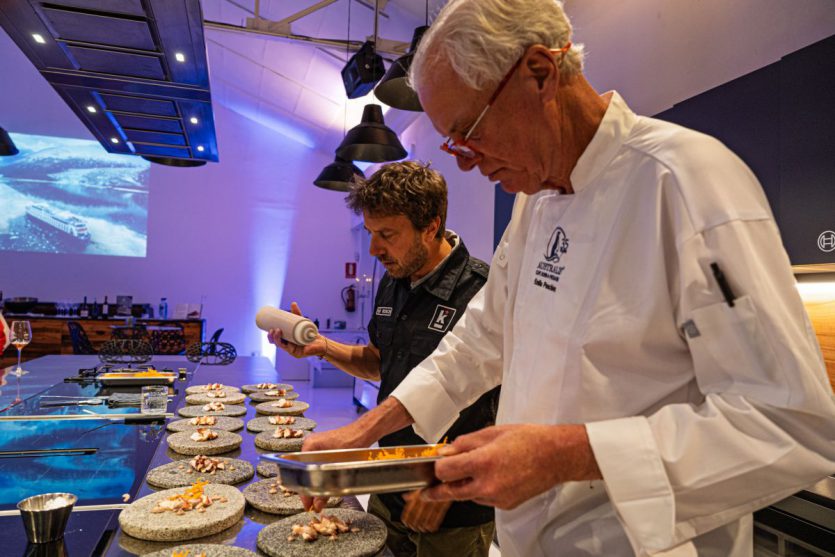
What makes Australis’ onboard cuisine different from other expedition cruises?
The short answer: the ingredients. The longer answer is about a philosophy that puts the raw material at the absolute center of every decision made in the kitchen.
Australis’ culinary program was built around a principle its gastronomic advisor has repeated for over a decade: aquí el producto manda — here, the product rules. This matters more than it might sound. Most cruise kitchens, regardless of their size or ambition, rely on a supply chain that is largely disconnected from the destination. On Australis, the opposite is true. We cook with local ingredients to make the experience more authentic.
The challenge, of course, is that this kitchen operates in genuinely extreme conditions. Both ships — the Ventus Australis, launched in 2018, and the Stella Australis — carry approximately 200 passengers across 100 cabins each, and they navigate remote channels where resupply is not an option and open-fire cooking is prohibited for safety reasons. Every plate served in the Patagonia Dining Room is the result of adapting exceptional local ingredients to a demanding operational reality. That constraint, far from limiting the result, has sharpened the cooking considerably.
What Patagonian ingredients will you find on the menu?
Understanding what you eat aboard Australis means understanding where these ingredients come from — and why they taste the way they do.
What is special about the centolla, or Magellanic king crab?
The centolla is the undisputed star of the southern seas. Caught exclusively in the cold subantarctic waters of the Magallanes region — the Beagle Channel, the Strait of Magellan, and surrounding fjords — in water temperatures of just 1 to 4°C, it is harvested by artisanal fishermen using baited traps in some of the most complex fjord geography on earth. The fishery follows strict sustainability rules: only males, only during open season, only above minimum size. The flesh is sweet, delicate, and exceptionally flavored in a way that simply cannot be replicated by farmed or transported crab. On board, it appears most memorably in a chupe de centolla — a rich, warming king crab preparation that has become one of the most emblematic dishes of the voyage.
What are glacier scallops, and why are they unique?
The glacier scallops — ostiones de glaciar — grow in the fjords where glacial meltwater mixes with saltwater, creating conditions so cold that these shellfish develop without coral. They are a relict species with no living relatives, existing nowhere else on earth except the Magallanes region.
Glacier scallops — ostiones de glaciar — grow in the fjords where glacial meltwater mixes with saltwater, creating uniquely cold conditions that shape their development. Endemic to the Magallanes region, they are part of a distinctive marine ecosystem found in the southernmost reaches of Patagonia.
On board, their presence reflects a broader commitment to responsible, small-scale tourism, with a focus on local sourcing and a deep respect for the environments we navigate. In the kitchen, they are prepared in ways that highlight both the delicacy of the ingredient and the Peruvian culinary influences woven throughout the onboard experience.
What is the mero magallánico, and why is it on the menu?
The mero magallánico — known as Patagonian toothfish, or Chilean sea bass — lives at depths of 1,000 to 2,000 meters below the surface. Unlike most fish, it has no swim bladder; instead, it regulates buoyancy through naturally high fat content, which is precisely why its flesh is so rich, buttery, and moist. It is one of the most prized fish in international markets, and it appears regularly on the Australis dinner menu — served simply, in ways that let the quality of the fish speak without interference.
What makes the local salmon different here?
The salmon served aboard comes from the pristine glacial-fed fjords around Punta Arenas and the broader Magallanes region — some of the cleanest cold water on the planet. It is smoked using lenga wood (Nothofagus pumilio), the native southern beech that forms the distinctive forests of Patagonia’s subpolar region. The lenga imparts a subtle, almost perfumed smokiness unlike any commercial smoking wood. The result tastes unmistakably of the place.
What role does Magellanic lamb play on the menu?
The Magellanic lamb is one of the most culturally significant ingredients in this part of the world. Raised in the open landscapes of the Magallanes region across hundreds of thousands of square kilometers, it carries an herbal, clean intensity that is immediately recognizable. The region has over three million sheep — more than half of Chile’s total — and the genetic isolation of the area has produced a meat that commands attention in European and Asian markets alike. Aboard Australis, it appears in the dinner rotation in preparations that prioritize the quality of the ingredient, adapting to what the kitchen can achieve with consistency and care in a remote maritime environment.
How does Australis adapt the iconic cordero al palo for life at sea?
This is the question every food-curious traveler eventually asks, and the answer reveals a great deal about the cooking philosophy on board.
Cordero al palo is one of the most iconic preparations in all of Patagonian cuisine. It consists on a whole lamb butterflied on an iron cross, slow-roasted vertically over an open fire for four to five hours. It is also, for obvious reasons, impossible to replicate on a ship: no open fire, no outdoor space, no uninterrupted four-hour window of cooking for 200 guests simultaneously.
So the kitchen asks a different question: what is the essence of cordero al palo? The answer is tenderness — that near-dissolving quality that comes from slow, patient heat. The result, whichever form it takes in a given season, always honors that principle: slow-cooked, carefully prepared, and served in a way that makes the quality of the Magellanic lamb impossible to ignore. Guests who have eaten traditional asado in Punta Arenas sometimes approach the plate with skepticism. They rarely leave it that way.
Does Australis cater to vegan and vegetarian passengers?
Australis operates a fully dedicated vegan menu running across the entire voyage, developed with the same care and seasonal thinking as the main menu. Every dish has been designed from the ground up using 100% plant-based ingredients, adapting traditional preparations rather than simply removing animal products. The kitchen’s own introduction to the vegan menu puts it plainly: “We have created the following selection of dishes with 100% plant-based ingredients, adapting each traditional preparation with alternatives of vegetable origin.”
In practice, this means creative, satisfying cooking — not a series of side dishes. Across the voyage, vegan guests can expect starters like a mushroom and cochayuyo ceviche (cochayuyo is a native Chilean seaweed), falafel on babaganoush, and zucchini rolls over fresh greens. Main courses include grilled eggplant stuffed with vegetables and chickpea hummus, stuffed zucchini with lentils stewed in a sherry-based sauce, a plant-based take on the traditional Chilean soy empanada with chancho en piedra sauce, and a fresh bean, sweet corn, and pumpkin stew (porotos granados) that is one of the great comfort dishes of Chilean cuisine regardless of dietary preference.
Desserts follow suit: a lemon semifreddo with strawberry gelée, a berry mousse with blueberry and blackberry sauce, and a carrot and walnut cake that stands up to any version on the main menu.
Vegetarian options are available as a standing choice at every dinner service, and the kitchen accommodates other specific dietary needs with advance notice. Guests traveling with dietary restrictions are encouraged to inform Australis before boarding.
What does a full day of eating look like aboard Australis?
The meal structure aboard both ships is designed around the rhythm of the expedition itself — excursions, landings, and the particular hunger that cold Patagonian air tends to produce.
The day starts early. A self-service café opens in the early hours of the morning — coffee, tea, hot chocolate, and something small to eat — for guests who want to catch the first light over the channel before the briefings begin. Breakfast follows as a full buffet: homemade pastries, artisanal bread, fresh fruit, cereals, yogurt, eggs cooked to order, and cold cuts.
Lunch and dinner are a four-course, waiter-served affair, served in the Patagonia Dining Room — a warm, contemporary space on the Ventus Australis with driftwood sculptures and regional artwork — with orders taken on advance so the kitchen can prepare with precision. The structure moves through a cold plated starter, a soup course, a choice of three main courses, and dessert. The pace is unhurried. The atmosphere is relaxed but considered. No dress code. No pressure. Just good food in a room full of people who spent the day somewhere extraordinary.
Throughout the day, Chilean and Argentine wines are included from 10:00 AM to midnight, alongside spirits, craft beers, and cocktails — all part of the all-inclusive service aboard both ships.
What is the post-excursion ritual, and why does it matter?
Ask anyone who has traveled with Australis what they remember most, and a surprising number will mention this: returning to the ship after a zodiac landing, cold and often wet, and being handed a cup of Magellanic chocolate — thick, warm, and touched with a measure of whiskey.
It is a small thing. It costs nothing in terms of culinary complexity. But it captures something essential about what Australis does well: the understanding that hospitality in this climate is not about spectacle, but about care. After two hours on a zodiac on the Beagle Channel with wind off the water, warmth is not a comfort — it is a necessity. The chocolate provides it. Guests remember it long after they have forgotten the dinner menu.
What is the signature cocktail, and what is the story behind it?
The Calafate Sour is Australis’ cocktail, and it comes with one of Patagonia’s most enduring legends. The calafate berry (Berberis microphylla) grows exclusively in southern Argentina and Chile, and its deep blue-black color turns a pisco sour into something visually striking — a vivid purple in the glass. The flavor sits somewhere between blueberry and something more tart and wild.
The Tehuelche legend says: el que come calafate, vuelve — whoever eats calafate will always return to Patagonia. According to the lore of the region, Calafate was a chief’s daughter transformed into a thorny bush to prevent a forbidden love; her lover became a bird who stayed with her until death. You serve the cocktail, you tell the story, and suddenly the Darwin Lounge is very quiet for a moment. It happens every time. If you want to know more about the drinks culture of Patagonia, the calafate berry turns up well beyond the cocktail — in jams, ice creams, and local confections throughout the region.
How does the kitchen maintain quality throughout the entire voyage?
Consistency across a season of remote expeditions — changing crews, no backup suppliers, electric stoves required by maritime safety regulations — is genuinely difficult. The answer, on Australis, is investment in people.
The culinary advisor’s training approach is direct: he travels to Punta Arenas to work alongside the kitchen team at the start of each season, brings onboard chefs to his Santiago restaurants so they can experience a consistent high standard from the other side of the pass, and embarks seasonally to supervise and adjust. The result is a kitchen culture that holds across the length of the voyage — one where a chef adjusts a sauce without being asked, and presents each plate as though it is the only one being served.
This approach also reflects Australis’ broader commitment to sustainable cruising. The company operates with approximately 200 passengers per ship, maintains partnerships with local suppliers in Punta Arenas and Ushuaia, and has eliminated single-use plastics from the onboard experience. To our journey through the most untouched and unknown part of Patagonia and Tierra del Fuego, we add a flavor experience thanks to the carefully crafted onboard cuisine. The food is not locally sourced as a marketing claim. It is locally sourced because the company’s model depends on the health of the region it sails through.
Conclusion
Food, in a place this remote, becomes something more than sustenance. It becomes evidence — of the quality of the water, the health of the fisheries, the care taken with local produce, and the intelligence of a kitchen that knows when to step back and let the landscape speak. Eating well aboard Australis is not incidental to the expedition. It is, in the truest sense, part of what you came to discover.
If the table at the end of the world has caught your attention, the full experience unfolds across Australis’ routes through the Strait of Magellan,Beagle Channel, and Cape Horn. Explore all available itineraries to be a part of the Australis experience.
Frequently asked questions
Is the food on an Australis cruise really all-inclusive?
Yes. All meals — breakfast buffet, lunch, and dinner — are fully included, as are unlimited drinks at the bar from 10:00 AM to midnight: Chilean and Argentine wines, spirits, craft beer, and cocktails. The only items billed separately are port taxes, suggested gratuities, and onboard store purchases.
Can Australis accommodate vegetarian or other dietary needs?
Yes. A vegetarian option is always available among the lunch dinner main courses, and the kitchen team accommodates specific dietary restrictions with advance notice. Also, a full vegan-course is served on board. Passengers have praised the chefs for preparing creative vegan meals and customized dishes on request.
What is the most emblematic dish served aboard Australis?
The chupe de centolla — a rich Magellanic king crab chowder — is probably the dish most associated with the voyage. The braised Magellanic lamb medallion with yogurt and mint is a close second, both for its flavor and for the story behind it: a traditional cordero al palo reimagined for life at sea.
What is the Calafate Sour?
Australis’ signature cocktail: a pisco sour made with calafate berries native to southern Patagonia. The berries give it a deep purple color and a flavor between blueberry and something more wild and tart. It comes with a Tehuelche legend: whoever eats calafate will always return to Patagonia.
When is Magellanic chocolate served?
Upon returning from zodiac excursion landings. It is a thick, warm cup of chocolate with a touch of whiskey — a small hospitality ritual that has become one of the most consistently remembered moments of the Australis experience.


You may also like…


No comments yet
There are no comments on this post yet.
Leave a comment