
Patagonia’s ten most breathtaking natural viewpoints include Mirador Base Las Torres overlooking iconic granite spires, Mirador del Glaciar Perito Moreno with its massive calving ice walls, and Mirador del Cerro Torre showcasing dramatic mountain peaks. Additional premier locations include Mirador Belvedere for Fitz Roy views, Cape Horn viewpoint offering unique perspectives where two oceans meet, Wulaia Bay viewpoint combining natural beauty with indigenous history, and Mirador de los Cóndores for wildlife observation. These viewpoints span both Chilean and Argentine Patagonia, with several accessible through comfortable transportation options and expedition cruise routes that allow travelers to experience multiple perspectives while maintaining quality accommodations between excursions.
Why Patagonia offers the world’s most spectacular viewpoints
Patagonia provides unmatched viewing opportunities because of its unique geological features. The region sits at the convergence of the Andes Mountains, Darwin Range and the Southern Patagonian Ice Field, creating landscapes where glaciers descend directly to sea level and mountains rise sharply from valleys and lakeshores. This concentration of natural wonders makes it possible to witness multiple ecosystem types and geological formations from strategic vantage points.
The region’s diverse geography creates compelling viewpoints across both northern and southern Patagonia. From accessible roadside overlooks to elevated mountain trails, and from maritime perspectives to historic landmarks, these viewing locations reveal glacier-carved valleys, crystalline lakes, and mountain walls that showcase the raw beauty of this wilderness region. Each viewpoint offers unique perspectives on landscapes shaped by millennia of glacial activity.
The 10 most breathtaking natural viewpoints in Patagonia
1. Mirador Base Las Torres (Chile) – iconic granite towers
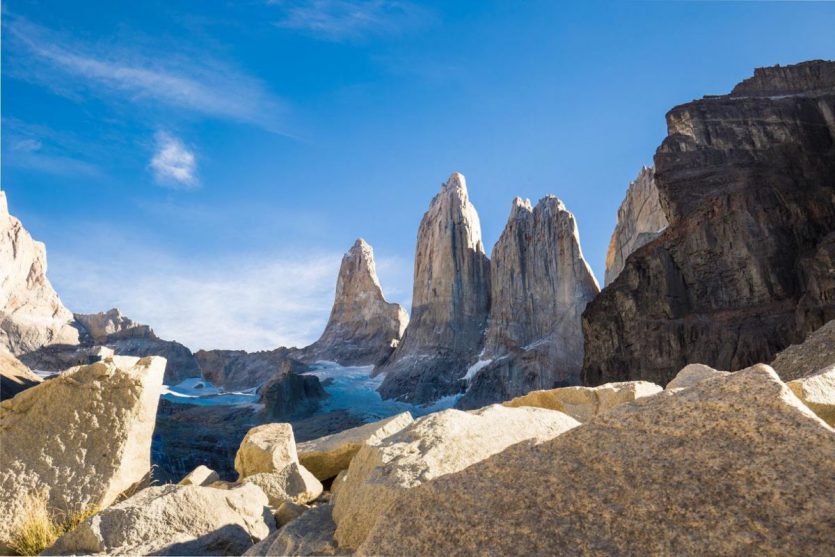
The Mirador Base Las Torres sits at the foot of three massive granite towers that define Chile’s most famous national park. This viewing location looks directly up at the dramatic spires rising vertically from a glacial lake, creating one of Patagonia’s most photographed scenes.
Reaching this viewpoint requires commitment. For trekking lovers, the trail from Torres del Paine’s entrance covers approximately 12.5 miles round trip starting near the Hotel Las Torres or the Park Entrance, with the final hour ascending a steep boulder field. The effort is rewarded with a pristine amphitheater where the towers reflect in the turquoise waters of Laguna Torres, surrounded by ancient ice and mountain walls.
Trail details:
- 12.5 miles round- trip from park entrance
- Final section: steep boulder field requiring moderate fitness
- Masive granite towers as the focal point
- Turquoise glacial lake reflecting the peaks
- Sunrise alpenglow lasting approximately 15 minutes
Best time to visit: October through April, with December to February offering the most stable weather conditions.
2. Mirador del Cerro Torre (Argentina) – the needle spire vista
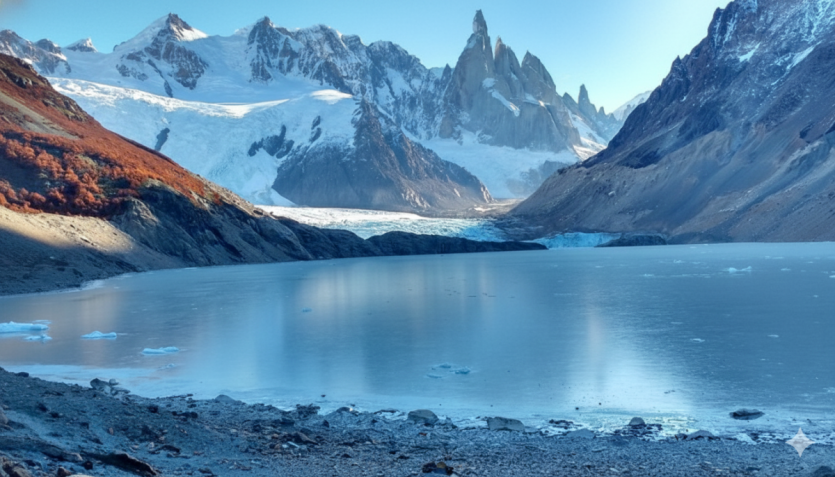
The Mirador del Cerro Torre viewing location presents one of mountaineering’s most challenging peaks from a relatively accessible lakeside position. This viewpoint faces the 10,280-foot Cerro Torre, often called the world’s most difficult mountain to climb due to its vertical granite walls and mushroom-shaped ice cap.
The trail from El Chaltén covers 11 miles round trip on moderate, rolling terrain through Patagonian steppe and riparian forests. The final approach emerges at Laguna Torre, where enormous icebergs from the Cerro Torre glacier float in milky blue water. The viewpoint sits on the lake’s edge with unobstructed views of the complete Cerro Torre massif.
Notable features:
- 10,280-foot Cerro Torre with near-vertical granite walls
- 11-mile round trip on moderate, rolling terrain
- Massive icebergs floating in glacial lake
- Complete view of Torre, Egger, and Standhardt peaks
- Accessible trail suitable for moderate fitness levels
Best time to visit: November through April for accessible trails and stable weather.
3. Mirador del Glaciar Perito Moreno (Argentina) – advancing ice spectacle
The Mirador del Glaciar Perito Moreno presents one of the world’s most accessible glacier viewpoints, where visitors stand face-to-face with a towering wall of ancient ice. Located inLos Glaciares National Park near El Calafate, this UNESCO World Heritage site features an extensive network of steel walkways and platforms.
What makes this viewpoint exceptional is the glacier’s active nature. Perito Moreno is one of the few advancing glaciers globally, and its constant movement produces regular calvings where house-sized chunks of ice break off and crash into Lago Argentino below. The viewpoint network spans nearly 2 miles of walkways at different elevations.
Key features:
- 200-foot-tall glacier face visible from multiple platforms
- Regular ice calvings creating dramatic displays
- Accessible walkways suitable for all mobility levels
- 19-mile glacier extending into the Andes
- Multiple viewing angles and photography opportunities
Best time to visit: December to February for most active calving, though year-round access is available.
4. Cape Horn viewpoint (Chile) – where two oceans meet
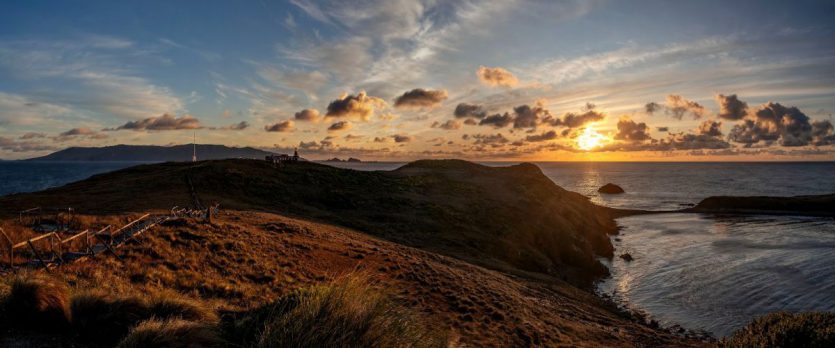
The Cape Horn viewpoint represents for many the southernmost point of the American continents, where the Atlantic and Pacific Oceans meet in often turbulent waters. Thislegendary maritime landmark offers views across Drake Passage.
This viewpoint differs from traditional mountain overlooks, as it’s accessible primarily by expedition cruise rather than hiking. From the viewpoint on Hornos Island, you look out over the notorious waters that challenged sailors for centuries. The surrounding cliffs drop dramatically to the sea, and on clear days, you can see the full sweep of the southern ocean. The Cape Horn lighthouse marks this historic location.
Historical significance:
- Southernmost point of the Americas
- Views toward Drake Passage
- Historic maritime route around South America
- Monument commemorating sailors lost rounding the Cape
- Weather station and lighthouse facilities
- No extensive hiking required for access
Best time to visit: November through March for calmer conditions and landing possibility via expedition cruise.
5. Mirador Belvedere (Argentina) – Mount Fitz Roy’s commanding presence
The Mirador Belvedere near Villa La Angostura provides sweeping panoramic views of northern Patagonia’s lake district. Located just outside this charming Andean town, this viewpoint offers 360-degree vistas of Nahuel Huapi Lake, surrounding mountains, and the distinctive landscape where Argentine Patagonia transitions from Andean peaks to rolling valleys.
The viewpoint is easily accessible, requiring only a short drive from Villa La Angostura’s center followed by a gentle 20-minute walk to the observation platform. From this elevated position, visitors can see the intricate shoreline of Nahuel Huapi Lake with its numerous bays and peninsulas, the town of Villa La Angostura nestled along the water, and the Andean mountain range extending into the distance. On clear days, views extend across both Argentine and Chilean territories.
Access and features:
- Short drive from Villa La Angostura center
- Gentle 20-minute walk to viewing platform
- 360-degree panoramic views of lake district
- Multiple lakes and mountain ranges visible
- Accessible year-round with minimal physical demand
- Suitable for all fitness levels including seniors
Best time to visit: Year-round accessibility, with autumn (March-May) offering spectacular foliage colors and summer (December-February) providing clearest visibility.
6. Mirador de los Cóndores (Argentina) – Andean condor observation point
Mirador de los Cóndores near El Chaltén offers exceptional opportunities to observe Andean condors in their natural habitat. This viewpoint sits along the trail to Laguna Torre, approximately 1.5 miles from the trailhead, where these massive birds with 10-foot wingspans frequently soar on thermal currents rising from the valley.
The location provides both wildlife observation and landscape appreciation. While watching for condors gliding at eye level, visitors enjoy views across the Río Fitz Roy valley toward the surrounding peaks. The relatively short distance from El Chaltén makes this an accessible half-day excursion.
Wildlife and viewing:
- Andean condors frequently visible soaring on thermals
- 1.5-mile easy walk from El Chaltén
- Valley and mountain views
- Multiple bird species using same thermal areas
- Educational interpretive signs about local wildlife
Best time to visit: Morning hours (8-11 AM) when thermal activity increases, year-round access.
7. Mirador del Río de las Vueltas (Argentina) – river and glacier perspectives
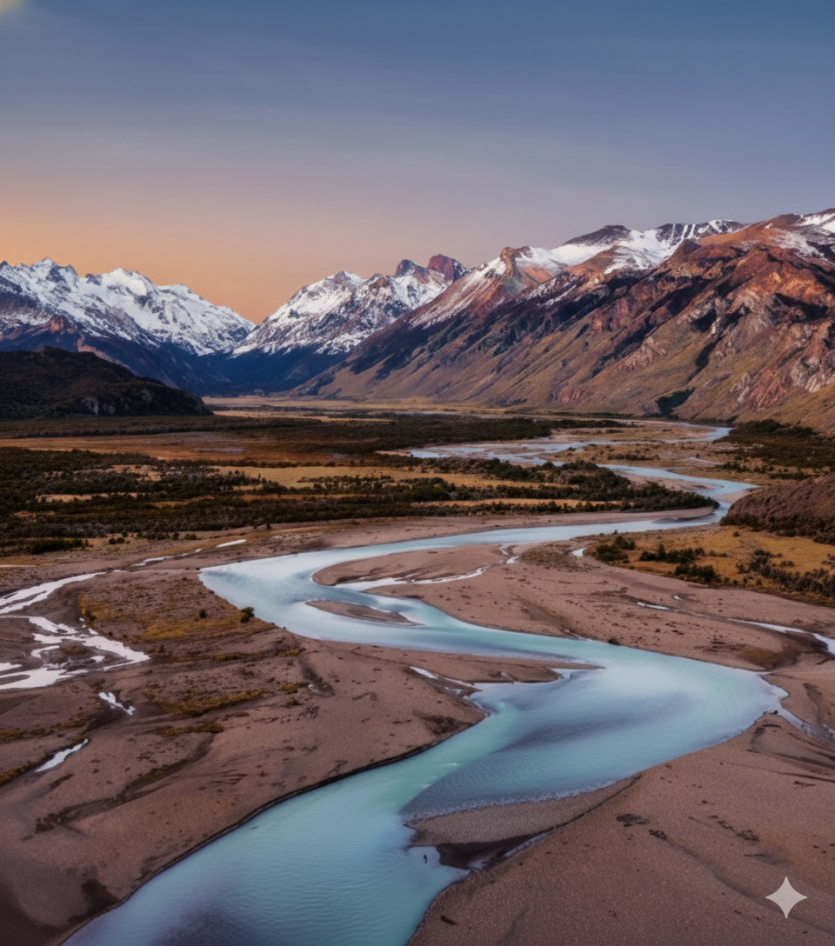
The Mirador del Río de las Vueltas provides views over the winding river that flows through El Chaltén’s valley, with glacier-fed waters creating a milky turquoise color distinctive of Patagonian rivers. This viewpoint sits along the approach to several major trails, offering perspectives on how glacial meltwater shapes the landscape.
From this location, visitors observe the river’s braided channels as they meander through the valley floor, with views extending to the glaciers that feed the river system. The contrast between the river’s blue-gray waters and the surrounding steppe vegetation creates a layered landscape typical of this region.
Viewing characteristics:
- Glacial river with distinctive turquoise color
- Braided channel patterns visible from elevation
- Views extending to glacier sources
- Accessible location near multiple trailheads
- Interpretive information about glacial hydrology
Best time to visit: November through March when river flow is highest from glacial melt.
8. Mirador Lago Grey (Chile) – overlooking ice and water
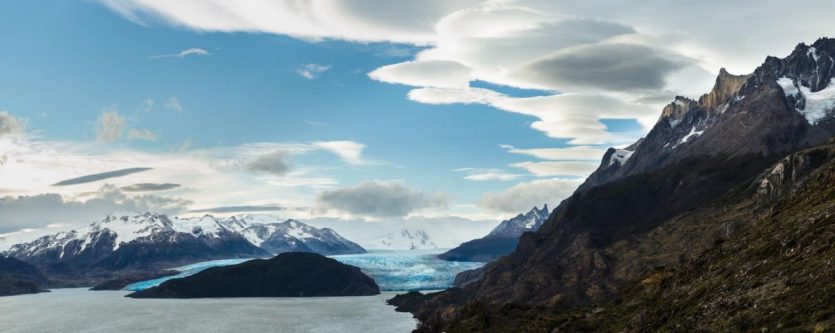
Mirador Lago Grey offers a sweeping perspective over Grey Glacier and the iceberg-filled lake of the same name within Torres del Paine National Park. This viewpoint sits elevated above the western section of the park, providing a bird’s-eye view of the glacier’s terminus and the massive ice field extending behind it.
The trail to reach this viewpoint begins at the park’s western camping areas and climbs gradually through southern beech forests. After approximately 2 hours of moderate hiking, the forest opens to reveal the full panoramic vista of Grey Lake dotted with blue and white icebergs.
Viewing highlights:
- 4-mile-wide glacier face visible from elevated position
- Icebergs floating in Grey Lake below
- Connection between ice field and glacier terminus visible
- 2-hour moderate hike through beech forests
- Comprehensive view of glacial dynamics
Best time to visit: December to March for clear conditions and optimal afternoon lighting.
9. Wulaia Bay viewpoint (Chile) – cultural and natural history combined
Wulaia Bay viewpoint provides perspectives that combine natural beauty with significant cultural history. Located on Navarino Island in the Beagle Channel area, this protected bay offers views across the channel to the mountains of Tierra del Fuego, while surrounding trails provide elevated perspectives over the bay and surrounding forests.
The viewpoint trail climbs through pristine Magellanic forest to a clearing overlooking the bay, channel, and distant peaks. This location holds historical significance as a former Yámana settlement, adding cultural context to the natural scenery. Accessible primarily via expedition cruise, this viewpoint requires moderate walking but no extensive hiking.
Combined features:
- Elevated forest trail to panoramic overlook
- Views across Beagle Channel to Tierra del Fuego mountains
- Historical Yámana indigenous settlement site
- Protected bay with calm water reflections
- Interpretive information about indigenous history
- Accessible via shore excursion from cruise vessels
Best time to visit: September through April for forest trail access and cruise season operations.
10. Mirador del Lago Mascardi (Argentina)- lakeside mountain reflections
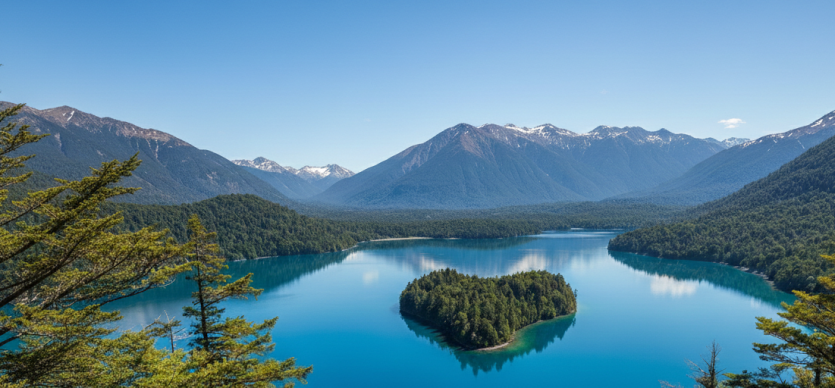
The Mirador del Lago Mascardi provides beautiful views of one of northern Patagonia’s most pristine lakes, situated along the famous Ruta de los 7 Lagos near Bariloche. This viewpoint overlooks the lake’s distinctive arms extending into surrounding valleys, with the Tronador volcano dominating the western horizon.
The viewing area is easily accessible from the main highway, with a short walk to the observation platform. From here, visitors see Lago Mascardi’s deep blue waters, often reflecting the snow-capped peaks that surround it. The lake’s unusual shape and multiple bays create visual interest from this elevated perspective.
Location features:
- Easily accessible from Ruta de los 7 Lagos
- Views of Tronador volcano and surrounding peaks
- Lake’s distinctive multi-armed shape visible
- Short walk from parking to viewing platform
- Part of larger scenic route with multiple stops
Best time to visit: Year-round access, with summer offering warmest conditions and autumn providing colorful forest surroundings.
Experiencing Patagonia’s viewpoints through diverse access options
Patagonia’s premier viewpoints offer varying levels of accessibility, from maritime observations to multi-hour hikes, ensuring travelers of different fitness levels can experience the region’s beauty. Several viewpoints are accessible without extensive hiking, including Cape Horn and Wulaia Bay (via expedition cruise), Perito Moreno platforms (via walkways), and shorter trails like Mirador Belvedere and Mirador de los Cóndores.
Access considerations for different viewpoints:
- Cruise-accessible (no extensive hiking): Cape Horn, Wulaia Bay
- Walkway/platform accessible: Perito Moreno Glacier
- Short walks (under 1 hour): Mirador Belvedere, Mirador de los Cóndores
- Half-day hikes (2-4 hours): Mirador del Río de las Vueltas, Mirador Lago Grey
- Full-day expeditions: Base Las Torres, Cerro Torre viewpoint, Laguna de los Tres
For those exploring southern Patagonia’s coastal regions, expedition cruises provide access to remote viewpoints like Wulaia Bay in the Beagle Channel and Cape Horn.. These maritime viewpoints offer unique perspectives without requiring extensive hiking, revealing Patagonia’s coastal beauty and tidewater glaciers.
Australis expedition cruises navigate through Chilean and Argentine Patagonia’s waterways, offering unique perspectives on glaciers descending to sea level, wildlife-rich islands, and historic landmarks like Cape Horn. These voyages provide comfortable accommodations between viewing opportunities, with expert naturalist guides providing context about the geological processes that shaped these dramatic landscapes.
Frequently asked questions
Which Patagonian viewpoints are most accessible for senior travelers?
Several viewpoints accommodate senior travelers comfortably without strenuous hiking. Cape Horn and Wulaia Bay are accessible via expedition cruise. The Perito Moreno platforms feature accessible walkways with gentle grades and benches at regular intervals. Mirador Belvedere involves a moderate 45-minute uphill walk that many fit seniors manage comfortably. For those preferring experiences without extensive hiking, Australis expedition cruises provide viewpoints accessible via short walks or directly from vessels.
How many days do you need to visit all 10 viewpoints?
Visiting all ten viewpoints requires approximately 8-12 days, depending on your pace and weather conditions. An efficient itinerary might allocate 4 nights for an expedition cruise (Cape Horn, Wulaia Bay), 2-3 days in El Chaltén (Cerro Torre, Fitz Roy viewpoints, Mirador de los Cóndores), 1-2 days at Perito Moreno, and 2-3 days in Torres del Paine (Base Las Torres, Lago Grey). Factor in travel days between regions, as distances are considerable. Weather-dependent closures or poor visibility may require schedule flexibility.
What’s the best time of year to visit Patagonian viewpoints?
The optimal season runs from September through April (southern hemisphere spring and summer), offering the longest daylight hours and most stable weather. December through February provides warmest temperatures and all facilities open, though these are peak tourist months. Shoulder seasons (November and March) offer fewer crowds with generally good conditions—March adds spectacular autumn colors in forested areas. Expedition cruises to Cape Horn and Wulaia Bay operate exclusively during this September-April window when weather conditions permit safe navigation and shore landings.
Do you need a guide to visit these viewpoints?
Most viewpoints don’t require guides. Cape Horn and Wulaia Bay are accessed exclusively via guided expedition cruise shore excursions. Perito Moreno’s platforms are self-guided with clear signage. Trails to Cerro Torre and Fitz Roy viewpoints are well-marked, though many hikers appreciate guides for natural history interpretation. Torres del Paine requires park registration but not mandatory guides for viewpoint trails. Hiring guides enhances experiences through expert knowledge of wildlife, geology, and optimal photography timing. For complex multi-day treks, guides handle logistics and safety considerations.
Can you combine mountain viewpoints with coastal Patagonia exploration?
Yes, many travelers successfully combine mountain and coastal Patagonia experiences. A comprehensive itinerary might include land-based exploration of mountain viewpoints (El Chaltén, Torres del Paine) combined with an Australis expedition cruise through the Beagle Channel and the Fjords of Tierra del Fuego to access Cape Horn and Wulaia Bay. Cruises typically depart from Ushuaia or Punta Arenas, accessible via flights from El Calafate. This combination provides diverse Patagonian perspectives—mountain peaks, glacial valleys, maritime viewpoints where oceans meet, and sites of indigenous cultural significance—creating a complete understanding of the region’s extraordinary landscapes.


You may also like…

No comments yet
There are no comments on this post yet.
Leave a comment